
Wide forefoot, narrow heel: look beyond the wide version
Space at the front and hold at the back are separate fit questions.
Published
If you have a wide forefoot and a narrow heel, a wide version is worth trying, but it may solve only half the problem. Look for room where your foot needs it and a secure hold where it does not.
The familiar compromise goes like this: the standard shoe squeezes the front of your foot, while the wide one lets your heel lift. You tighten the laces to hold the back down, then feel pressure across the top. Going up another size gives your toes space, but leaves even more shoe behind them.
This is a shape problem as much as a width problem. Treating your entire foot as “wide” hides the useful detail.
Separate width, shape and volume
Width describes space across the foot. Toe-box shape describes how that space tapers towards the toes. Volume includes the room above your foot and through the instep. Heel hold concerns how securely the rear of the shoe wraps your heel. Those things interact, but they are not interchangeable.
A shoe may feel spacious across the ball of the foot yet press on the little toe because its front tapers sharply. Another may offer enough width but feel shallow over the toes. A generous upper can feel loose through the midfoot even when the length is right.
Room at the front and hold at the back need separate answers.
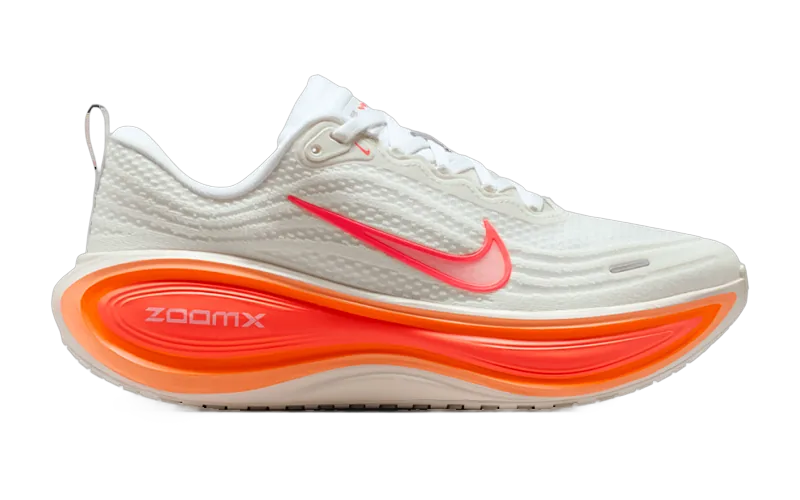
- Heel and collar
- Does your heel stay comfortably seated as you move?
- Midfoot and instep
- Can the laces hold your foot without pressure across the top?
- Forefoot and toes
- Is there enough width, length and height without squeezing?
Nike Vomero Plus catalogue image for orientation, not a recommendation for this foot shape. A side photograph cannot establish the internal width or fit.
What does a wide version change?
Check the specific model rather than assuming every brand changes width in the same way. Brooks lists several width options, with availability varying by model and colour. The width label is useful when choosing what to try, but it does not tell you whether that shoe's heel will suit you.
A roomy toe box is also different from a wide fit throughout. Altra explains that distinction in its FootShape guide: its fits combine toe room with different amounts of midfoot space, and some models also have a separate wide option. That is a useful example of why two shoes described as roomy can fit differently.
It is not a reason to choose a brand unseen. Your forefoot may need space further back than the toes, and a shoe's heel can still fail to hold you. Try the exact model and version. A family name is not a fit guarantee.
Try to solve one conflict at a time
Wear the socks and insoles you intend to run in. Check both feet, standing and moving, with the heel properly seated. First establish suitable length. Then notice where pressure or movement occurs, using the three areas above.
If length is good but the forefoot feels squeezed, compare a wider option or a different front shape. If the front feels comfortable but the heel repeatedly lifts, compare a different heel and midfoot fit. Avoid buying extra length solely to escape side pressure, then trying to lace away the excess.
Small lacing changes can be worth trying during the fitting. The useful result is comfortable hold. If holding the heel requires enough tension to make the instep uncomfortable, you have not resolved the conflict. Do not plan to tolerate numbness or painful pressure until the shoe “breaks in”.
Describe the location, not just the width
A fitting conversation becomes much more useful when you can say, “The front feels good in the wide version, but my heel lifts,” rather than “I need a wide shoe.” Bring your current pair if possible and explain what works as well as what fails.
You might discover that a different model in its standard fit works better than the first model in wide. You might also find the wide option is exactly right. The objective is a comfortable fit across the whole foot, without a heroic lacing arrangement.
When asking Cinda for options, describe the forefoot pressure, heel movement and any instep issue separately, alongside models that have fitted well. It can help narrow the comparison. A catalogue recommendation still needs a real fitting to establish whether that combination works on your feet.