
Why two carbon-plated running shoes can feel so different
The plate is one part of the ride. Here is what else to compare.
Published
Two carbon-plated shoes can feel very different because the plate works inside a complete shoe. The foam around it, the plate's shape, the curve of the sole, the width of the platform and the upper all contribute to what reaches your foot. “Carbon-plated” identifies a construction feature. It does not tell you whether a shoe feels soft, stable, flexible or comfortable at your pace.
The PUMA Deviate NITRO 4 and PUMA Deviate NITRO Elite 4 make a useful comparison. Both have PWRPLATE technology, but one is a training shoe and the other is a lighter race-focused design. Their similar names make it particularly easy to underestimate the differences.
What does a plate actually change?
A plate changes how the sole resists bending. Its material is only part of the design: thickness, curvature, position within the foam and the surrounding sole shape also matter. A shoe can therefore have carbon in its name without feeling like another carbon shoe you enjoyed.
It is also too simple to picture the plate as a spring supplying the whole benefit. In a study by Laura Healey and Wouter Hoogkamer, 15 male runners were tested at 14km/h in intact and modified Nike Vaporfly 4% shoes. Cutting the plate reduced bending stiffness without a statistically significant change in running economy in that experiment. That is a finding about a particular shoe and experimental change, not proof that plates never matter. It does show why separating the plate from the rest of the construction can mislead.
The foam sets much of the character
Softness and rebound describe different sensations. A foam can compress deeply under your foot without giving the sharp return you associate with a racing shoe. Another can feel firmer and more immediate. The amount of foam beneath different parts of your foot also affects how much cushioning you notice.
In its standard Deviate NITRO 4 listing, PUMA specifies NITROFOAM and a carbon-composite PWRPLATE. Its Elite 4 launch description identifies NITROFOAM ELITE and a redesigned carbon-fibre plate. Those are different constructions, despite the shared family name.
Two related plated shoes, built around different priorities. This maps manufacturer construction details and researched ride characteristics; it is not a controlled laboratory comparison.
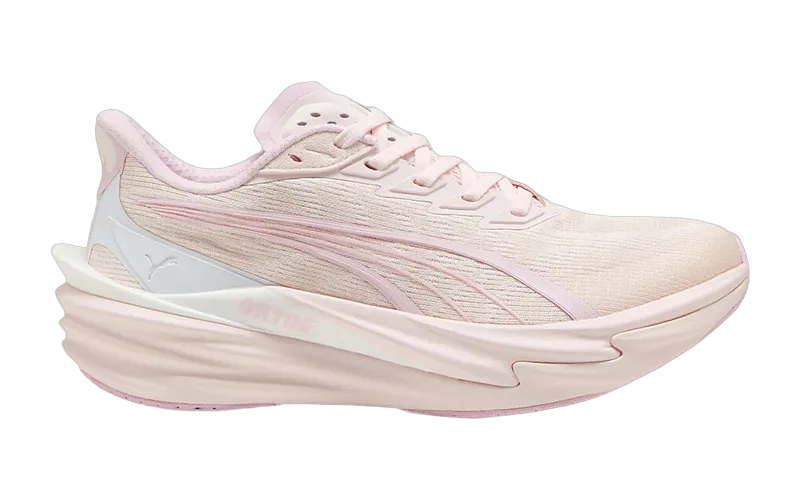 PUMA Deviate NITRO 4
- Training priorityNITROFOAM + carbon-composite PWRPLATE + a more padded training upper.
A connected, structured option for purposeful road training. 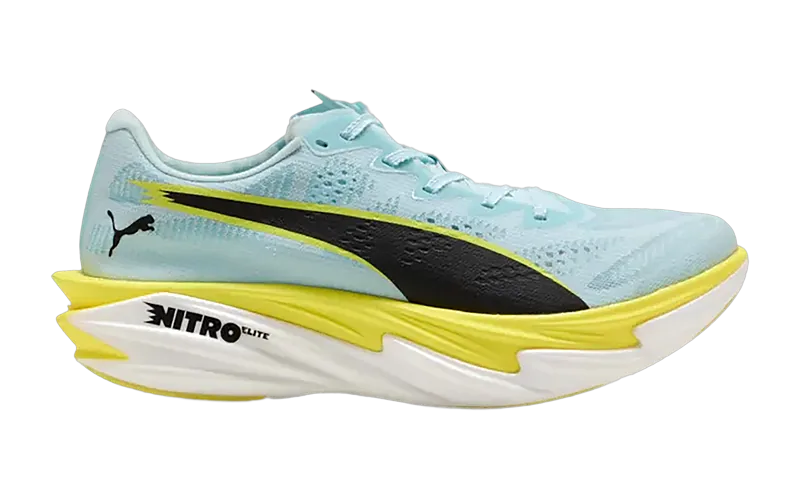 PUMA Deviate NITRO Elite 4
- Racing priorityNITROFOAM ELITE + redesigned carbon-fibre PWRPLATE + a lighter race-focused build.
A more pronounced rolling character, with a narrower heel platform to assess.
The curve and platform change the transition
The rocker is the curved shape that helps the shoe roll as you move over it. Its position and shape can make a shoe feel smooth at one pace and awkward at another. That sensation is distinct from the firmness of the foam or how readily the forefoot bends.
Our model research describes the standard Deviate NITRO 4 as grounded and agile, with a structured forefoot rather than a tall, floating sensation. The Elite 4 has a more pronounced rolling character and a narrow heel platform. If you dislike feeling perched on a shoe when jogging or turning, that platform deserves attention even if the cushioning feels excellent in a straight line.
Width is not a simple stability guarantee either. Consider where your foot sits, how much the foam compresses and whether the upper holds you securely. A broad-looking outsole and a loose upper can still be an unhelpful combination for you.
The upper is part of the ride
A padded collar and tongue can make a trainer feel more forgiving around the foot. A pared-back racing upper trades some of that material for lower weight. Neither tells you automatically which shoe will fit: check heel hold, pressure across the instep and room around the toes.
The same applies to outsole coverage. Two shoes using the same rubber family can put different amounts in different places. Do not transfer every grip or durability conclusion from one model to its lighter racing relative. If winter roads are the main concern, start with the wet-road guide and the exact shoe's evidence.
Compare the shoes for your run
These PUMA examples use model-specific research and primary construction descriptions, with UK listings checked on 20 October 2026. They are not a personal head-to-head mileage test. Try both at a relaxed pace and the pace you intend to use, where a retailer permits it. Pay attention to the transition, forefoot comfort and control through a turn, as well as the first impression of bounce.
Choose a plated trainer if you enjoy that construction for your workouts. Investigate a race-focused shoe if you want its particular ride for racing. There is no requirement to own both, and a more expensive plate does not establish a better match. If resistance under your toes is the problem, the guide to faster shoes without a full-length plate gives you another route.
In Cinda, describe the ride you enjoy and the session you want to cover, with your existing rotation as context. “Carbon” can stay on the specification sheet while fit, feel and purpose decide what you actually try.